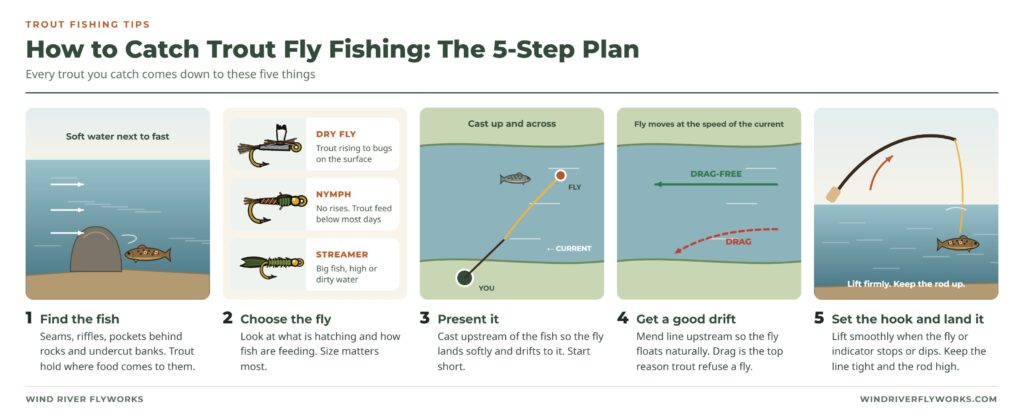
Catching a trout on a fly rod isn’t luck. Every fish you hook comes down to the same five things: you fished where a trout was, you showed it a fly it wanted to eat, the fly arrived naturally, it drifted like real food, and you set the hook at the right moment. Get those right and you’ll catch fish. Miss one and you won’t.
This guide pulls together the most important trout fly fishing techniques into one simple plan. Each step links to a more detailed guide if you want to go deeper.
The 5-Step Plan for Catching Trout
Step 1: Find the Fish
Trout aren’t spread evenly through a river. They hold where they can get food without fighting the current all day, and where they feel safe. Look for:
Seams: the line where fast water meets slow water.
Riffles and runs: broken, oxygen-rich water and the deeper, walking-speed water just below it.
Pocket water: the soft spots behind and in front of boulders.
Undercut banks and shade: cover from birds and other predators.
Foam lines: where the current collects bugs.
Trout also move with the seasons and the time of day. Our guide on how to read a river for trout shows where to look in every type of water.
Step 2: Choose the Right Fly
Start by asking how the trout are feeding:
Trout rising to the surface? Fish a dry fly that matches what’s hatching. See our dry fly fishing guide.
No rises? That’s most days. Trout eat most of their food under the surface, so fish a nymph. Our nymph fishing guide explains how.
Bigger fish, high or off-color water, or no luck with smaller flies? Try a streamer. See our streamer guide.
Match the size first, then the shape, then the color. Our guide to choosing flies and matching the hatch covers the bugs trout eat and the eight best trout flies to carry.
Step 3: Present the Fly
How the fly arrives matters as much as which fly you chose.
Approach quietly. Trout see and feel movement. Stay low, wade slowly, and wear muted colors.
Cast upstream and across. Fish face into the current, so coming from below and behind keeps you out of their view. Land the fly a few feet upstream of where you think the fish is.
Start short. Fish the water closest to you first, then work farther out. Long casts aren’t needed for most trout.
Land it softly. Aim the cast slightly above the water so the line unrolls and the fly settles gently.
New to casting? Our guide on how to cast a fly rod covers the basic cast, the roll cast and common mistakes.
Step 4: Get a Drag-Free Drift
“Drag” is when your line pulls the fly faster or slower than the current, or sideways across it. Real bugs don’t do that, and trout know it. Drag is the most common reason a fly gets refused.
Mend your line. Right after the fly lands, flip the line upstream with a small roll of the rod tip so the current doesn’t belly it downstream.
Keep line off the water. Hold the rod tip up and keep as little line on the water as you can, especially across fast current.
Use the right tippet. Finer, longer tippet lets the fly move more naturally. See our leader and tippet guide.
Get deep enough. When nymphing, your fly should tick the bottom now and then. If it never does, add weight or lengthen the distance to your strike indicator.
Step 5: Set the Hook and Land the Fish
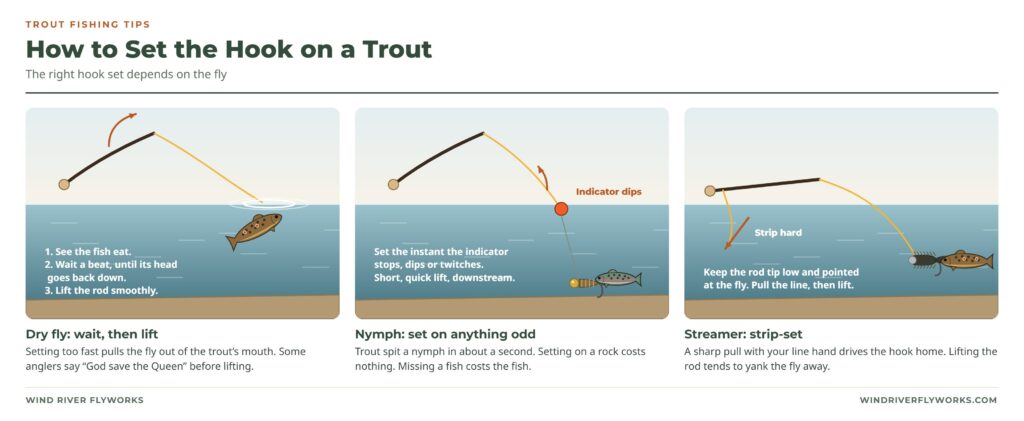
The right hook set depends on the fly:
Dry flies: wait until the trout closes its mouth and turns down, then lift. Setting too fast is the most common way to miss a rising fish.
Nymphs: set the instant your indicator stops, dips or twitches. Trout spit a nymph in about a second. A quick, short lift downstream works best.
Streamers: use a strip-set. Pull the line sharply with your line hand, keeping the rod low, then lift once you feel weight.
Once a fish is on, keep the line tight and the rod tip up. Let the fish run if it wants to, and reel in when it stops. Use a net with a rubber bag, keep the fish in the water as much as possible, and wet your hands before handling it. Release it facing upstream so water flows over its gills.
Troubleshooting: Why Am I Not Catching Trout?
No bites at all? You may be in empty water or not deep enough. Move to a better spot, or add weight and fish closer to the bottom.
Trout rising but refusing your fly? Drop a hook size or two, try an emerger, or lengthen your tippet. Check for drag.
Fish spooking? Your approach or cast is too loud. Slow down, stay farther back, and land the fly more softly.
Missing strikes? On dries, wait longer before you set. On nymphs, set faster and keep less slack in your line.
Losing fish after the hook set? Keep tension on the line and check your knots and hook point.
More Trout Fishing Tips
Fish early and late in summer. Cooler water means more active trout. Give the fish a rest when water tops about 68°F.
Cover water. Make a few good drifts through each spot, then take a step upstream.
Watch the water before you fish. A minute of looking often tells you where the fish are and what they’re eating.
Learning how to catch trout fly fishing is a matter of putting five pieces together: find the fish, choose the right fly, present it quietly, get a natural drift, and set the hook the right way for that fly. You won’t get all five right every time, and that’s part of the fun. Each day on the water teaches you a little more. Pick one step to work on next time out, and the trout will start to come.
Shop This Article
Stickers and gear that go with this guide, drawn by Nick and printed in the USA.