The Elk Hair Caddis is one of the most reliable dry flies ever tied, but plenty of anglers only fish it one way. Knowing when to use an Elk Hair Caddis, how to pick the right size and color, and the different ways to fish it will turn it from a “maybe” fly into one you reach for with confidence.
This guide covers what the fly imitates, the seasons and conditions when it shines, how to select a good one, and four ways to fish it. If you want the history and why it belongs in every box, start with our introduction to the Elk Hair Caddis.
What the Elk Hair Caddis Imitates
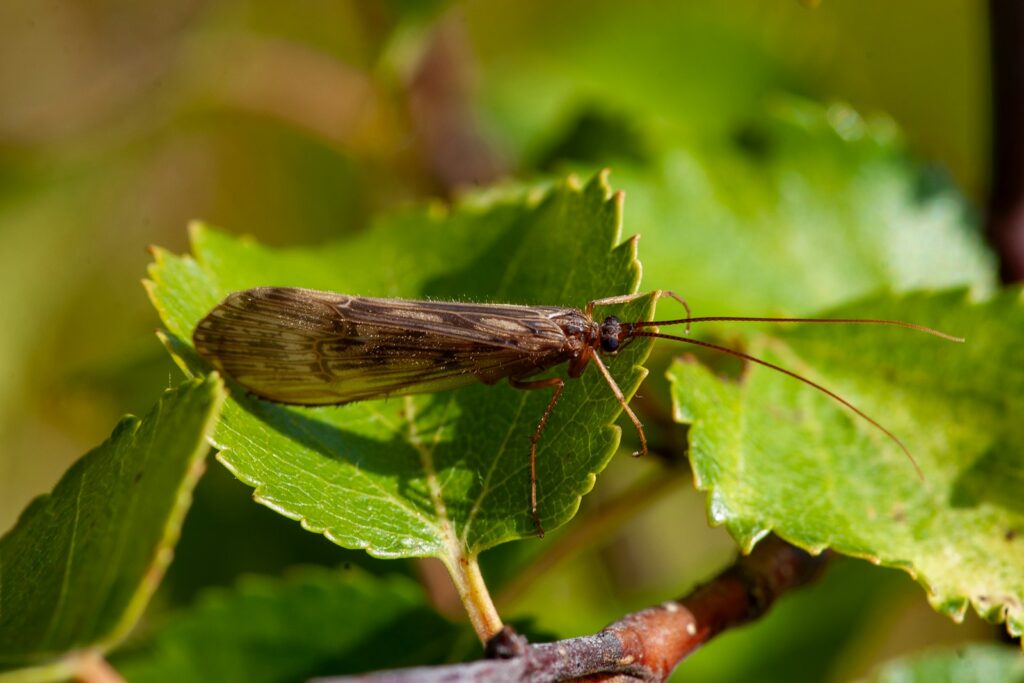
The Elk Hair Caddis copies an adult caddisfly. Caddis are moth-like insects with wings folded into a tent shape over their backs, no tails and long antennae. They hatch on nearly every trout stream in North America, and trout eat them from spring through fall.
An adult caddis resting on streamside brush. The tent-shaped wings and long antennae are what the Elk Hair Caddis is built to suggest.
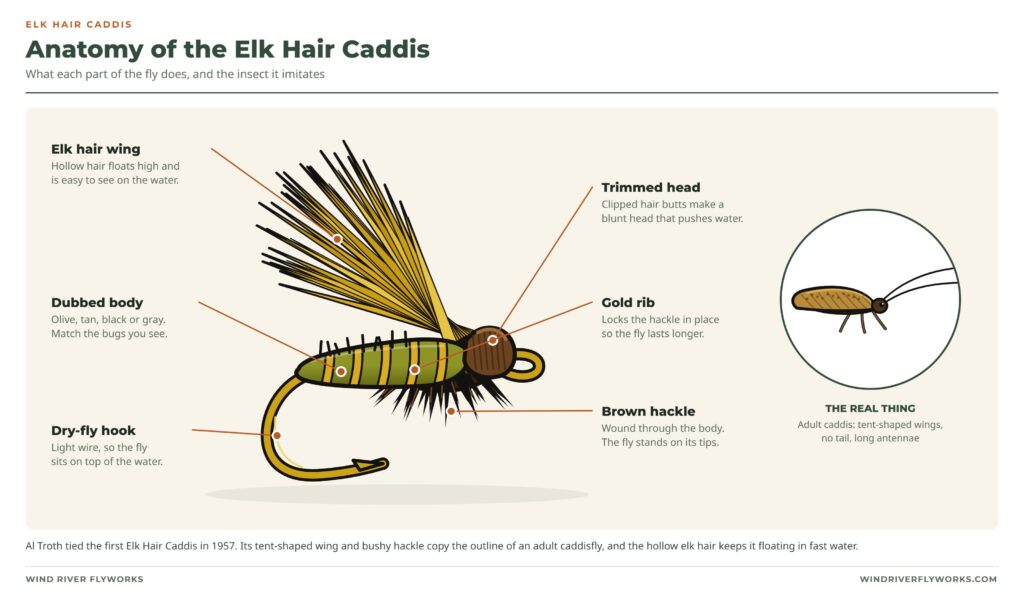
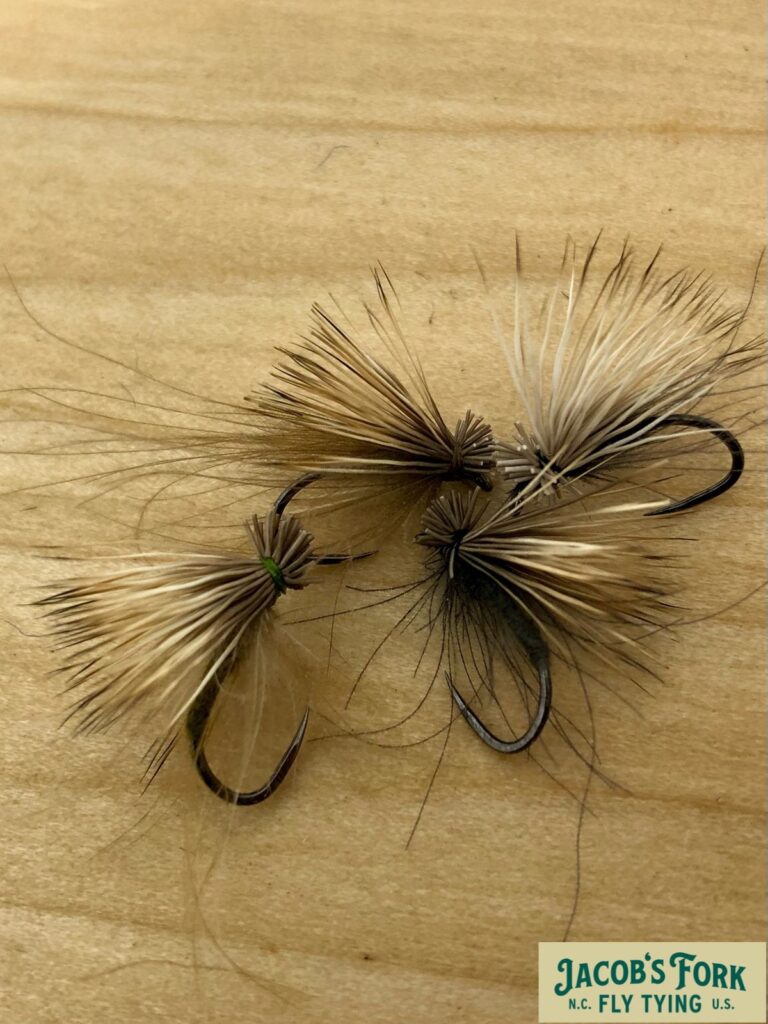
Each part of the fly has a job. The hollow elk hair wing floats and gives the tent-shaped outline. The hackle wound along the body lets the fly sit up on the surface. The gold wire rib holds that hackle in place so the fly survives more than a few fish.
Because its shape is “buggy” rather than exact, the Elk Hair Caddis also passes for small stoneflies, moths and even small hoppers along grassy banks. That’s why it works even when nothing is hatching.
When to Use an Elk Hair Caddis
Time of year
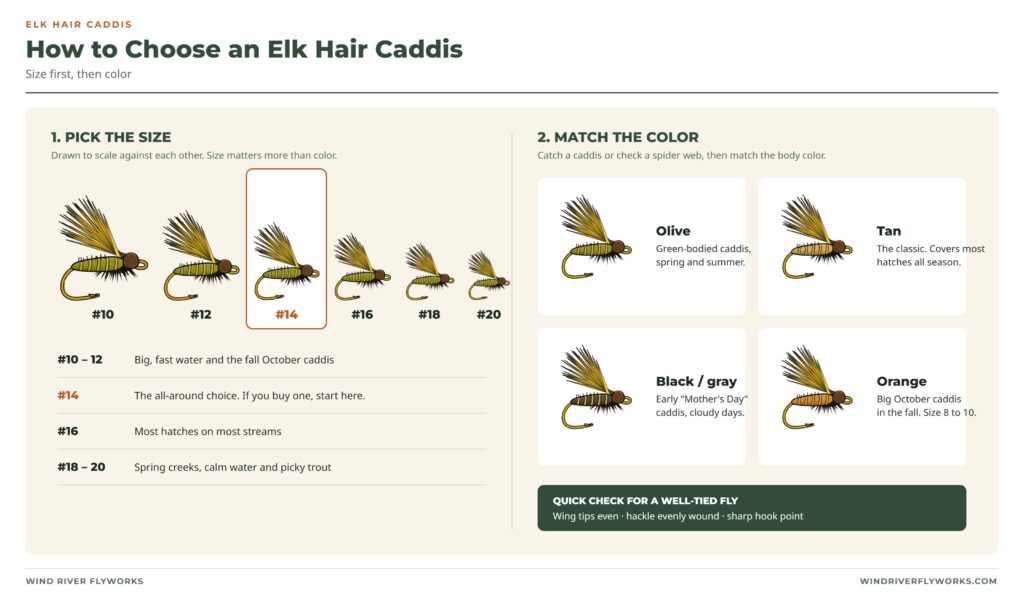
Spring: the famous “Mother’s Day” caddis hatch comes in late April and May on many rivers. Dark gray or black flies in size 14 to 16 match it well.
Summer: caddis hatch almost every day. Tan and olive in size 14 to 18 cover most of what you’ll see.
Fall: big orange October caddis appear in September and October on many western rivers. Go up to size 8 to 10 in orange.
Time of day
Caddis activity often peaks in the evening, from late afternoon until dark, when females return to the water to lay eggs. Overcast, humid days can bring caddis out at any hour.
Signs that it’s caddis time
Small, moth-like bugs fluttering low over the water or bouncing off the surface.
Splashy rises, or trout leaping clear of the water. Caddis move fast, so trout chase them hard. Our dry fly guide shows how to read rises.
Caddis crawling on streamside rocks, brush and spider webs. Shake a bush and see what flies out.
Little cases made of sand and twigs stuck to underwater rocks. Those are caddis larvae.
Where to fish it
The Elk Hair Caddis floats well in riffles, pocket water and fast runs, where many dry flies would sink. It’s a great choice for broken water where trout have to decide quickly. Learn to find those spots in our guide to reading a river.
How to Choose an Elk Hair Caddis
Match the size first, then the color. Catch a caddis or check a spider web, hold it next to your fly, and choose the closest match. If you can’t find a bug to look at, a tan size 14 is the best place to start.
Signs of a well-tied fly
Wing: the elk hair should be stacked so the tips are even, and they should reach just past the bend of the hook. A wing that’s too long can make trout miss.
Hackle: evenly wound along the body with no big gaps. Hackle fibers about the length of the hook gap help the fly ride high.
Head: trimmed butts should be neat and tight, not loose or falling apart.
Hook: sharp, with no rust. Many anglers mash the barb down for easier releases.
Variations worth carrying
Hi-vis Elk Hair Caddis: a bright post or wing helps you see the fly in glare or low light.
X-Caddis: a sparkle shuck tail and no hackle. It sits lower in the film and works on picky fish.
Goddard Caddis: a spun deer-hair body that floats like a cork in very fast water.
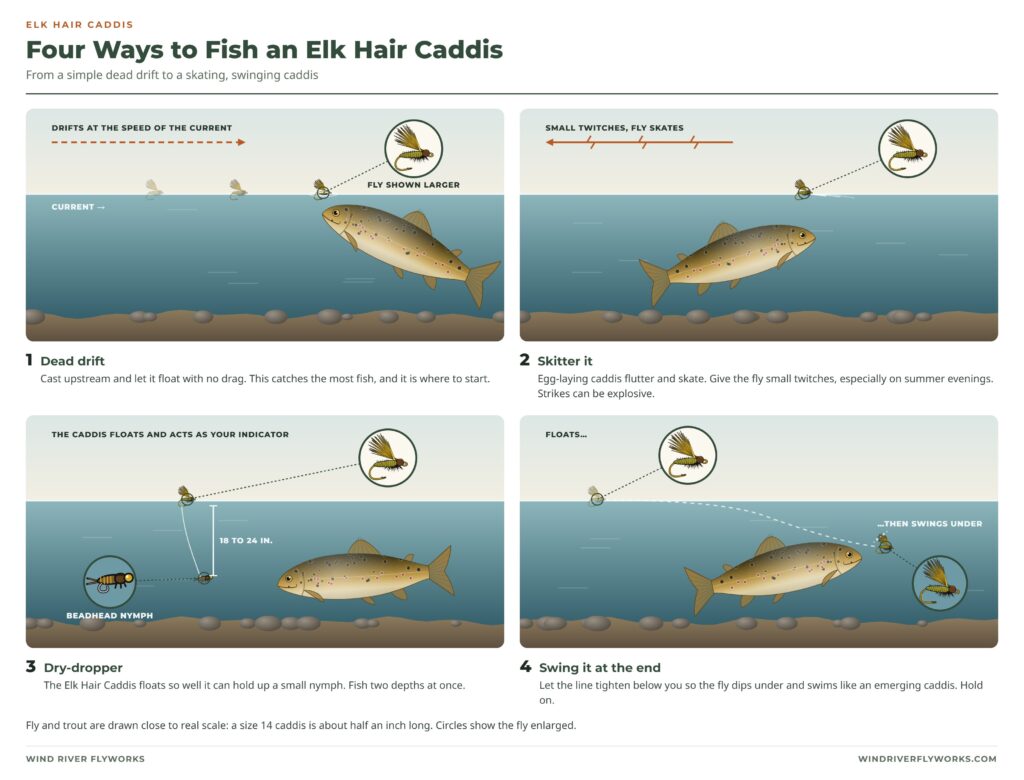
There’s more than one way to fish this fly. Start with a dead drift, and if trout ignore it, try one of the other three.
1. Dead drift
Cast slightly upstream of a rising fish or a likely spot and let the fly float with the current, with no drag. Mend your line so the fly moves at the same speed as the bubbles around it. This is how you’ll catch the most fish.
2. Skitter it
Egg-laying caddis flutter and skate across the surface. On summer evenings, lift your rod tip slightly to make the fly twitch and skate a few inches, then let it sit. Trout often hit hard, so keep a light grip.
3. Dry-dropper
The Elk Hair Caddis floats well enough to hold up a small nymph. Tie 18 to 24 inches of tippet to the bend of the hook and add a small beadhead nymph or caddis pupa. You fish two depths at once, and the dry fly works as your indicator. Read more in our nymph fishing guide.
4. Swing it at the end of the drift
When the fly drifts below you, let the line come tight. The fly will dip under and swim across the current like an emerging caddis. Trout grab it hard, so hold on.
Your Setup
Rod: a 3- to 5-weight rod is ideal for most caddis fishing.
Leader: 9 feet, ending in 4X for sizes 12 to 14 and 5X for sizes 16 to 18. See our leader and tippet guide.
Knot: an improved clinch knot is all you need. Our knot guide shows how.
Floatant: treat the fly before you fish it. After a fish, rinse it, squeeze it dry, and false cast a few times.
Troubleshooting
Trout rise but miss the fly: they may be eating emerging caddis just under the surface. Trim the hackle on the bottom so the fly sits lower, or switch to an X-Caddis.
Refusals: drop a size, check your drift for drag, or try a different color.
Fly keeps sinking: dry it off and add floatant. In very fast water, try a Goddard Caddis.
Can’t see the fly: use a hi-vis version, or watch for any rise where you think your fly is and set the hook.
Final Thoughts
The Elk Hair Caddis earns its reputation because it’s simple, tough and versatile. Fish it in the riffles on a summer evening, match the size and color to the bugs you see, and don’t be afraid to make it move. Learn these four ways to fish it, and this one fly can cover most of your dry fly fishing from spring to fall.