Your leader is the clear, tapered line between your fly line and your fly. It’s the part of your setup that fish actually see, and a good fly fishing leader setup makes a huge difference in how your fly lands and drifts. Get it wrong and your casts pile up, your fly drags, and trout refuse it.
This guide explains how a tapered leader works, what fly fishing leader length to use, how to read a tippet size chart, how to attach tippet, and when to choose 5X vs 6X tippet.
What a Leader Does
Fly line is thick and easy for fish to see. A leader does three jobs:
It hides the connection between the bright, thick fly line and the fly.
It transfers energy. A tapered leader carries the energy of the cast from the line all the way to the fly, so the fly “turns over” and lands straight.
It lets the fly move naturally. A thin tippet lets a dry fly float freely and a nymph sink and drift.
Anatomy of a Tapered Leader
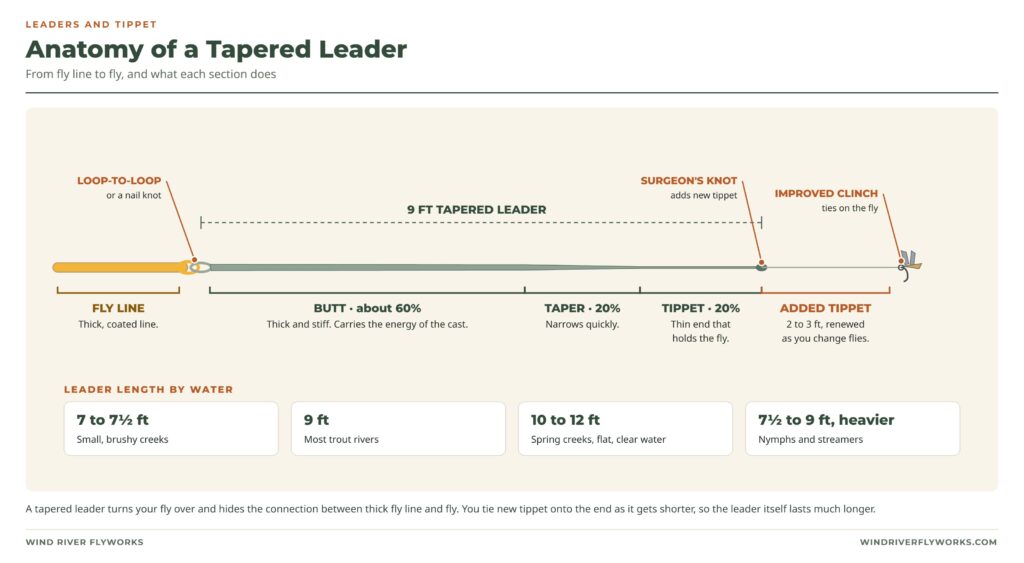
A standard tapered leader has three sections:
Butt section (about 60%): thick, stiff line that attaches to your fly line and carries the cast.
Taper (about 20%): where the diameter drops quickly.
Tippet (about 20%): the thin end that holds the fly.
When you buy a “9 ft 5X leader,” the 5X tells you the size of the tippet end. Every time you change flies you lose a few inches, so you add new tippet from a spool to keep the leader the right length.
Fly Fishing Leader Length
Start with a 9 ft leader for most trout fishing and adjust from there:
7 to 7½ ft: small, brushy creeks where you make short casts.
9 ft: the all-around length for most rivers and lakes.
10 to 12 ft: spring creeks and flat, clear water where fish are spooky.
7½ to 9 ft with heavier tippet: nymph rigs and streamers, where you need more control than stealth.
Longer leaders are stealthier but harder to cast, especially in wind. If your fly won’t turn over, shorten the leader or the tippet.
Tippet Size Chart
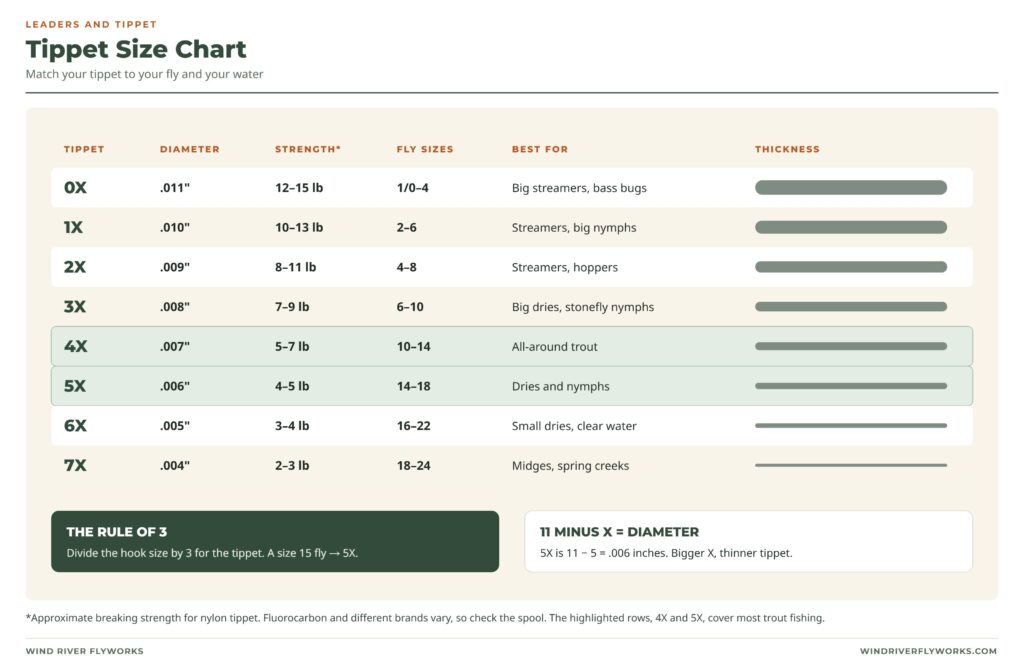
Tippet is sized by “X.” The bigger the number, the thinner and weaker the tippet. Here’s a quick reference:
Two easy rules help you remember:
The rule of 3: divide your fly’s hook size by 3 to get the tippet size. A size 15 fly is about 5X; a size 12 is about 4X.
11 minus X: subtract the X number from 11 to get the diameter in thousandths of an inch. 5X is .006 inches; 3X is .008.
5X vs 6X Tippet
This is one of the most common questions in fly fishing. Here’s how to choose:
Use 5X as your default for trout. It handles flies from about size 14 to 18, it’s strong enough for good fish, and it’s forgiving for beginners.
Drop to 6X for small dry flies (size 18 and smaller), flat, clear water, and picky trout that keep refusing your fly. It’s less visible and lets small flies drift more naturally.
Go up to 4X or 3X for nymph rigs with split shot, bigger flies, heavy current or larger fish.
If you’re breaking off fish, go one size heavier. If fish are refusing your fly, try one size lighter.
Nylon or Fluorocarbon?
Nylon (monofilament) floats a bit, stretches, is easier to knot and costs less. Great for dry flies.
Fluorocarbon sinks faster, is harder for fish to see underwater and resists abrasion. Great for nymphs and streamers. It costs more.
Many anglers use a nylon leader with fluorocarbon tippet for nymphs.
How to Attach Leader to Fly Line
Most modern fly lines come with a welded loop at the end, and most leaders come with a loop in the butt. Join them loop-to-loop: pass the leader loop over the fly line loop, then feed the whole leader through the fly line loop and pull it snug. Done right, the loops lock together like a square knot.
No loop on your line? Use a nail knot to attach a short butt section with a perfection loop. Both knots are in our guide to 7 essential fly fishing knots.
How to Attach Tippet
Cut 2 to 3 feet of tippet from your spool.
Overlap it with the end of your leader by about 6 inches.
Tie a double surgeon’s knot: form a loop with both lines, pass the ends through twice, wet it and pull all four ends tight.
Trim the tags and tie on your fly with an improved clinch knot.
Tippet is usually one size smaller than the end of the leader (for example, 5X tippet on a 4X leader) or the same size.
Common Leader Problems
Fly lands in a pile: the tippet is too long or too thin for the fly. Shorten it or go heavier.
Wind knots: small overhand knots in the leader weaken it badly. Cut them out and retie. They usually come from a tailing loop in your cast.
Leader too short: after many fly changes, add a new section of tippet or replace the leader.
Old tippet: tippet weakens with sun and age. Replace spools every season or two.
Keep Your Setup Dialed
A 9 ft leader, a spool each of 4X, 5X and 6X tippet, and two good knots will handle most trout fishing. Match the tippet to the fly, adjust for the water, and your casts and drifts will get better right away. Next, put it to work with our guides to dry fly fishing and nymph fishing.
Shop This Article
Stickers and gear that go with this guide, drawn by Nick and printed in the USA.